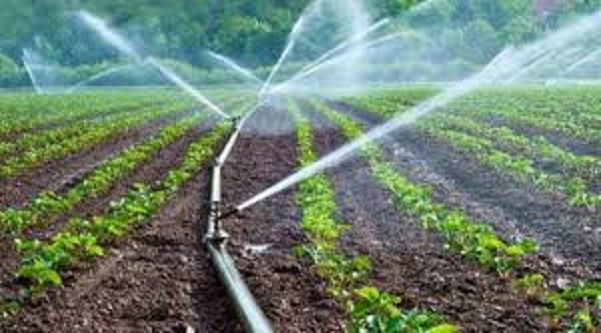
Irrigation means supply of water to agriculture from canals, wells and tanks artificially or manually. India is an agricultural country. It depends on monsoonal rains for agricultural aspects. Due to break of monsoons or its failure, temporal variability in rainfall, temperarature and other climate elements and low crop yields, high yielding varieties of crops needed regular moisture supply,
in large sections of the country, due to this it creates dry spells and also due to rapid population growth and demand of food grains to meet the population extension of irrigation facililities became a matter of urgency.
Artificial supply of water to the crops depends oh different factors like the country’s river system (perennial/non perennial), river catchment area, rainfall, characteristics, surface configuration and geological characteristics, economic and political systems of the country and policy of the government. It is one of the most important critical inputs for enhancing the productivity that is required at different.
Major and Medium Irrigation Sector:
During the plan period, rapid harnessing of water resources was the prime objective and to develop water resources projects for irrigation, flood control, hydro power generation, drinking water supply, industrial and other miscellaneous uses, and a large number of dams, barrages, hydro power structures, canal network etc. Were constructed all over the country in successive Five Year Plans. This contributed significantly to achieve self sufficiency in food production.
User’s participation in major and medium irrigation schemes received greater attention. Repairs and improvement to the minor irrigation projects, as a part of integrated micro development, also received encouragement.
Similarly, sprinkler and drip irrigation programmes and the conjunctive use of surface and ground water gained momentum. 2022- India’s total area under irrigation is 64.7 million hectares.
Minor Irrigation Sector:
In 1951 with an irrigated potential of only 22.60 Mha of which the contribution of Minor Irrigation was 12.90 Mha (surface water 6.40 Mha and ground water potential 6.50 Mha).
The momentum picked up after 1980 particularly for ground water schemes. For minor irrigation scenario as a whole, the cumulative potential created by the end of the Xth Plan is estimated to be 60.42 Mha.
Surface Water Development: The growth in surface water irrigation potential has been modest. The criterion of minor irrigation schemes as those with estimated cost of less than Rs.25 lakhs was changed to culturable command area basis (less than 2000 ha) in 1978.
Thereby, some of the earlier conceived medium irrigation schemes consisting of large dams and canal networks came under the scope of minor irrigation.By the end of the Ninth Plan, a potential of 13.60 Mha has been created and 11.44 Mha utilized against ultimate potential of 17.38 Mha.
Ground Water Development: Ground water meets nearly 55% of irrigation requirements of the country. It has contributed immensely to drought proofing of agriculture.
Over the years, rapid expansion in the use of ground water primarily for irrigation has contributed to agricultural and economic development of India. “The ground water development in hard rock terrains of Tamil Nadu, Andhra Pradesh, Telangana and Karnataka, States is also very high. Ground water development in Rajasthan, which covers part of Thar desert, is 125%.
Though, over development of resources in some parts of the country has created serious problems, a large portion of GW resources are still untapped in eastern and north eastern parts of the country mainly in the States of Assam, Bihar and West Bengal. Several Posts and Blogs are available in Internet for further information.
IMPORTANT INTERNATIONAL TREATIES
Indus Water Treaty:
The treaty was signed in Karachi on 19th September, 1960, by Indian Prime Minister Jawaharlal Nehru and President of Pakistan Mohammed Ayub Khan. It concerned with sharing of water of Indus and its tributaries between India and Pakistan. According to it, India has the exclusive power to use the waters of three Eastern rivers (Sutlej, Beas and Ravi), however, India can use only 20% of the total discharge of the Indus River System under the regulation of the Indus Water Treaty.
India-Bangladesh Treaty:
Joint River Commission (JRC) was formed for the effective management of the common river system. In 1996, treaty for sharing of water of Ganga at Farakka was signed.
India-Nepal Treaty:
A Nepal-India Joint Committee on Water Resources (JCWR) was formed. A treaty on Integrated development of Mahakali was signed in 1996. Pancheshwar Multi Purpose Project on river Mahakali was the centrerpiece of Mahakali Treaty.
India-China Cooperation:
A Memorandum of Understanding (MoU) was signed between India and China to share hydrological information such as rainfall, water level on Brahmaputra river,
India-Bhutan Cooperation:
A Joint Expert Team (JET) was formed in 1979 to review the progress of scheme for the establishment of Hydro-meteorological and flood forecasting Network on rivers stages of plant growth of various crops for optimum common to India and Bhutan.