*****Please Visit My Youtube Channel ComTech.Rstvarthi for Engineering Entertainment Educational Filmy shorts.*****
Jammu and Kashmir:
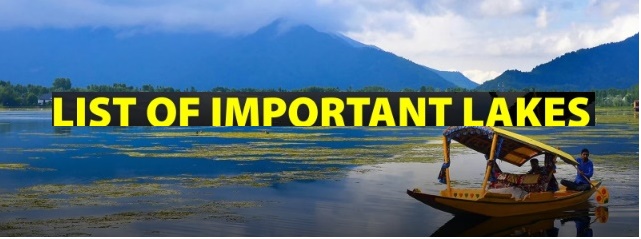
Dal Lake – Srinagar District of J&K. It is a freshwater lake, fed by the river Jhelum. It is known for houseboats and has some interesting flora like lotus flowers, water lilies and water-chestnut. It is also known as the “Jewel in the crown of Kashmir” or Srinagar’s Jewel. Nigeen Lake – Srinagar District of J&K. It is a natu- ral freshwater lake with channels connecting it to the river Jhelum. It is also known as “Jewel in the ring”. Anchar Lake – Srinagar District of J&K. The lake is connected with the famous Dal lake via a channel called Amir Khan Nallah.
Wular Lake – Bandipur District of J&K. It is one of the largest freshwater lakes in Asia. Wular Lake was formed as a result of tectonic activity and is fed by the river Jhelum. It was declared a Ramsar wetland site in 1990. * Manasbal Lake – Ganderbal District of J&K. It is a natural freshwater lake.
Gadsar Lake – Ganderbal District of J&K. Gadsar in Kashmiri means “lake of fishes”.
Gangabal Lake – It is a freshwater lake located at the foothills of Mount Harmukh in the Ganderbal dis- trict of J&K
Sheshnag Lake – Anantnag District of J&K. It lies on the way to Amarnath Shrine.
Marsar Lake – Anantnag District of J&K.
Tarsar Lake – Anantnag district of J&K. Tarsar lake is separated from its sister lake, Marsar by a moun- tain peak with an elevation of 4000 m.
Mansar Lake – Jammu city of J&K. It is a Ramsar Wetland Site.
Surinsar Lake – Jammu city of J&K. It is a Ramsar Wetland Site.
Ladakh:
Pangong lake – It is located in Ladakh. It is an endorheic lake and allows no outflow to other external bodies of water such as rivers or oceans, but drainage converges instead into lakes or swamps, permanent or seasonal, that equilibrate through evaporation. The Line of Actual Control passes through this lake.
Tso-moriri Lake– Tso moriri lake is a lake in the Changthang Plateau in Ladakh. It is declared as a Ramsar Wetland site.
Himachal Pradesh:
Chandra Tal Lake – It is a high altitude lake in the Lahaul and Spiti district of Himachal Pradesh. It is about 4300 m above sea level. It is a freshwater lake and is near the source of the Chandra river (a source river of Chenab). The name of the lake originates from its crescent shape.
Suraj Tal Lake – It lies below the BaraLacha Pass in Lahaul and Spiti valley of Himachal Pradesh. The lake is just below the source of the Bhaga river that joins the Chandra river downstream to form the Chandrabhaga river, also known as Chenab.
Nako Lake – It is a high altitude lake located in the district of Kinnaur, Himachal Pradesh. This lake is surrounded by willow and poplar trees. Near the lake, there are four Buddhist temples.
Khajjiar Lake – It is located in the Chamba district of Himachal Pradesh.
Uttarakhand:
Bhimtal – It is situated near the town of Bhimtal in the Kumaon Division of Uttarakhand. It is the largest lake in the Nainital district which is also known as the “Lake district of India”. There is an island at the centre of the lake.
Roopkund Lake – It is a high-altitude glacial lake situated in the Chamoli district of Uttarakhand. It is also known as “Mystery Lake or Skeleton’s lake” as it is widely known for the hundreds of ancient human skeletons found at the edge of the lake.
Sattal or Sat Tal Lake – Sattal is an interconnected group of seven freshwater lakes near Bhimtal town of the Kumaon Division of Uttarakhand.
Rajasthan:
Sambhar Lake – It is the largest inland salt lake. It is located 80 km to the south-west of Jaipur. Sambhar Lake has been designated as a Ramsar Site.
Dhebar Lake/Jaisamand Lake It is located in the Udaipur district of Rajasthan. It is the second-largest artifi- cial lake in Asia. Maharana Jai Singh built this lake during the construction of a dam on the Gomti river (Rajasthan).
Pushkar Lake – It is an artificial lake, situated in the town of Pushkar in the Ajmer district of Rajasthan. It is a sacred lake of the Hindus. Udaisagar Lake – It is an artificial lake situated around 13 km in the east of Udaipur. The lake was built by Maharana Udai Singh.
Mansagar Lake – It is an artificial lake situated in Jaipur, the capital city of Rajasthan. It was built by Raja Man Singh by damming the Dravyavati river. Jal Mahal, an architectural monument, is situated amidst the Mansagar lake.
Maharashtra:
Lonar Lake – Also known as Lonar Crater Lake, it is located at Lonar in Buldhana district, Maharashtra. Lonar Crater lake was formed as a result of the accumulation of water in the crater or depression formed in the basaltic rock.
The crater is believed to have been formed by a meteorite collision during the Pleistocene Epoch. + Gorewada Lake – It is situated on the north-west corner of Nagpur city. It was developed by the Water Works Department as the primary source of drinking water for the population of Nagpur. More Information on Lakes are available over internet in Posts and blogs.
Odisha:
Chilika Lake – It is a brackish water lagoon, spread over the Puri, Khurda and Ganjam districts of Odisha state. This lake is the largest coastal lagoon in India. Chilika lake was designated the first Indian wetland of international importance under the Ramsar Convention due to its rich biodiversity.
Hirakud Dam – It is built across the Mahanadi river and is one of the largest man-made (artificial) lakes in the world.
Tsongmo Lake – Also known as Changu Lake. It is a glacial lake, about 40 km away from the capital Gangtok. It remains frozen during the winter season. It is a sacred lake for Buddhists and Hindus. Khecheopalri Lake Chot-Palri (meaning heaven of Padmasambhava), lies Originally known as Kha- in west Sikkim. It is sacred for both Buddhists and Hindus and is believed to be a wish-fulfilling lake. Kerala
Kanjia Lake – It is a natural lake located on the northern outskirts of Bhubaneswar, Odisha.
Vembanad Lake – It is the longest lake in India as well as the largest in the state of Kerala. It is the sec- ond-largest Ramsar Wetland Site in India (the first being the Sunderbans in West Bengal).
Ashtamudi Lake – It is the second-largest Lake in Kerala, situated in the Kollam district of Kerala. It is the entrance to the famous backwaters of Kerala. It is also a Ramsar Wetland Site.
Ansupa Lake – It is a fresh-water lake, located on the left bank of the Mahanadi river, opposite Banki in Cuttack district, Odisha.
Sasthamkotta Lake – It is the largest freshwater lake in Kerala (Kollam district). It has also been des- ignated as a Ramsar Wetland Site.
Tamil Nadu:
Kaliveli Lake – It is a coastal lake in the Viluppuram district of Tamil Nadu. This lake is on the coromandel coast, near the Bay of Bengal. It is one of the largest wetlands in Peninsular India.
Kolavai Lake – The Kolavai lake is in the Kancheepuram district of Tamil Nadu, which is perennial in nature. Andhra Pradesh
Andhra Pradesh:
Kolleru Lake – It is one of the largest fresh-water lakes in India and forms the largest shallow fresh- water lake in Asia. It is located between Krishna and Godavari deltas and serves as a natural flood balanc- ing reservoir for these two rivers. The lake was declared as a wildlife sanctuary in 1999 under the Wildlife Protection Act of 1972 and was also designat- ed as a Ramsar Wetland Site in 2002.
Pulicat Lake – It is the second largest brackish water lake in India (after Chilika lake). It lies on the border of Andhra Pradesh and Tamil Nadu. The barrier island of Sriharikota separates the lake from the Bay of Bengal. It is the habitat of numerous local and migratory birds.
Manipur :
Loktak Lake – It is the largest natural fresh-water lake in is famous for the phumdis floating over it. Keibul Lamjao North-eastern India. It is located at Moirang in Manipur. It National Park is located on this phumdi which is the only floating national park in the world. The park is the last natural refuge of the endangered Sangai (state animal of Manipur). It has been designated as a Ramsar Wetland Site and is also listed under the Montreux Record.
Sikkim:
Cholamu Lake/Tso Lhamo Lake It is India’s highest lake, situated in North Sikkim, about 4 km south side.
Karnataka:
Ulsoor Lake/Halasuru Lake – It is one of the biggest lakes in Bangalore.
Ayyanakere Lake – It is near Sakharayapatna village of Karnataka, at a distance of 18 km from Chikmagalur.
Telangana:
Hussain Sagar Lake – It is situated in the city of Hyderabad. It was built across a tributary of the Musi river by Hussain Shah Wali in 1562 during the reign of Ibrahim Quli Qutub Shah.
Osman Sagar – It is an artificial lake in Hyderabad. It was made by damming the Musi river in 1920 by the then Nizam of Hyderabad, Osman Ali Khan.